Rupert Maycroft
The LighthouseRupert Maycroft is the resident secretary of the Combe Island Trust and a former country-town solicitor whose orderly life has been unsettled by bereavement and his move to the island. He serves as a measured intermediary between the Trust’s rules, its residents, and the police investigation into Nathan Oliver’s death. The murder does not turn him into a detective, but it tests the habits of caution and responsibility by which he has long managed his life.
Identity and Earlier Life
At fifty-eight, Maycroft has good health and, as far as he can tell, an unimpaired mind, yet he has retired early from his legal practice and spent eighteen months on Combe Island. His departure from ordinary professional life followed the death of his wife in a car accident. She was driving to a book-club meeting when her Mercedes collided head-on with a tractor on a narrow country road. In the first weeks after her death, practical duties—the inquest, funeral, and correspondence—occupied him; later, grief overwhelmed him, bringing remorse, guilt, and an indistinct longing he had not anticipated.
The Trust had been a client of his firm, and Maycroft first accepted a temporary appointment to fill the interval between resident secretaries. The position gave him a way out of his practice; when he was offered the permanent job within two months, he accepted. The office and its view helped draw him to the island: from the tower of Combe House he could see the harbour entrance and the restored, no-longer-functioning lighthouse on its rocky spur. The island’s beauty offered consolation, but it also unsettled the settled assumptions on which he had built his life.
Self-Examination and the Island
Maycroft’s eighteen months on Combe Island have brought more peace but also more persistent inward questioning. Looking back, he recognizes a life shaped by protection and expectation: an over-guarded childhood, conventional schooling, an expected Oxford degree, and entry into his father’s profession more from filial respect and the promise of secure work than from a deliberate vocation. His marriage, too, had been a choice among suitable acquaintances rather than a passionate decision. He wonders whether being an only child, cherished and overprotected, helped keep him from difficult choices, danger, and achievements beyond his work.
That reflection gives his island appointment a double significance. It is both an escape from the routines that once supported him and an exposure to the questions those routines had kept at bay. Combe’s landscape can console and disturb at once; Maycroft finds himself more at peace there, yet more liable to scrutinize the compromises of his past. His responsibility for the island community consequently rests alongside a private sense that he has only recently begun to examine how he arrived at his present life.
The Secretary’s Decisions
Maycroft considers his first eighteen months as secretary reasonably successful, but identifies two appointments as mistakes. Dan Padgett and his mother arrived at the end of June 2003 after Dan had written asking about work as a cook and handyman. The island did not need a cook, but the handyman was about to retire, and Mrs. Plunkett had indicated that she could use extra help. Maycroft accepted the application, which came with a persuasive letter and a reference.
The arrangement soon carried a burden beyond the job description. Mrs. Padgett was gravely ill and had only months to live; she had long imagined Combe Island as a refuge and was determined to spend that remaining time there. Dan devoted much of his time to caring for her, with assistance from Joanna Staveley and, sometimes, Mrs. Burbridge. No one complained, but Maycroft understood that others were carrying the cost of his decision. Dan was a capable handyman, yet made clear without words that he disliked island life. Maycroft had heard that, after his mother’s death, Dan would probably leave; the judgment that he was not truly an islander weighed heavily in a community defined by belonging.
The second appointment was Millie Tranter, whom Maycroft took in after Jago found her homeless and begging in Pentworthy. Jago asked whether she could return on the launch while arrangements were made, rather than leave her exposed to predatory men or hand her over to the police. Maycroft gave her a room in the stable block and work helping Mrs. Burbridge with linen and Mrs. Plunkett in the kitchen. That practical arrangement was going well, but he remained anxious about her future: although legally an adult, Millie seemed to him unpredictable and childlike, and could not remain on the island indefinitely. These decisions show the secretary’s care for vulnerable people, but also his awareness that taking someone in creates obligations he cannot simply resolve by offering a job or a room.
The Murder Investigation
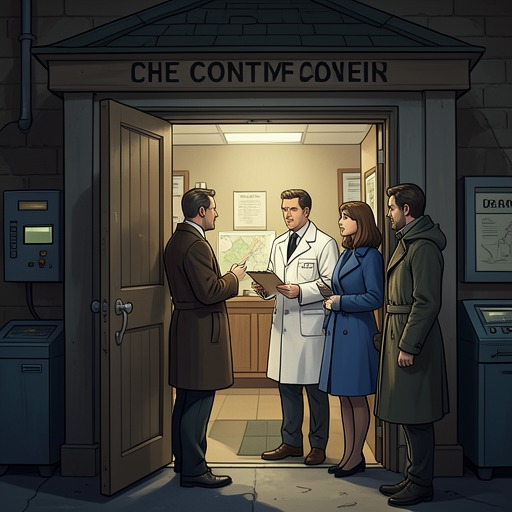
When Adam Dalgliesh’s team arrives, Maycroft identifies himself as the Trust’s secretary and introduces Guy Staveley as his colleague and resident physician. He also places Dan Padgett in a subordinate, practical role, asking him to look after the investigators’ bags. In an early search for Oliver, Maycroft gathers a small party that includes Dr. Staveley, Dan, and Emily Holcombe. As mist thickens over the island, he judges that there is no point searching far until it lifts and limits their immediate effort to the lighthouse. His response is characteristic: he organizes what can be done while taking account of the island’s conditions.
Maycroft is cooperative with the investigation, but he does not disguise the history of friction between Oliver and the Trust. Oliver visited regularly, and his arrival was not welcome to the secretary. Maycroft describes him as demanding, critical, sometimes uncivil to staff, and inclined to nurse grievances. The Trust deed required admission for anyone born on the island, but did not specify the frequency or duration of visits; Oliver was its only living island-born claimant. Maycroft also explains a more immediate conflict: Oliver wanted Atlantic Cottage, but Emily Holcombe had a right under the Trust’s terms to live on the island for the rest of her life and would not leave. Maycroft would not ask her to move. In laying out these tensions, he gives Dalgliesh both the formal constraints and the personal resentments surrounding Oliver’s presence.
During the inquiry, Maycroft asks that Dr. Staveley join his interview with Dalgliesh. Dalgliesh understands that this is less an attempt to help the police than a lawyer’s wish to have a witness to what is said; he sees no reason to object. Maycroft’s legal training therefore shapes even his cooperation: he is willing to assist, but attentive to procedure, accountability, and how an exchange may later be understood. He also speaks for the island community in acknowledging the shock of Oliver’s death and the violent manner of it.
Leadership in a Worsening Crisis
Maycroft’s responsibilities become more difficult when Adrian Boyde is also murdered and the community’s sense of Combe as secure and self-contained is shaken. Addressing the residents, he expresses their shock at the death of a man who belonged to their community, promises cooperation with Inspector Kate Miskin, and warns that the island may have been too readily assumed to be impregnable. He proposes that residents move into Combe House or the stable accommodation, lock their cottages, and give the police access to search for an intruder. Emily Holcombe objects to leaving Atlantic Cottage, and Maycroft’s plan is presented as a practical proposal rather than a power to compel every resident.
The public-health emergency complicates this police response. Guy Staveley reports that Raimund Speidel has SARS and that Dalgliesh has become infected; he recommends voluntary quarantine for the island’s residents. Maycroft has to manage an island already under pressure from murder, illness, and restricted movement, while the investigation continues with limited personnel and resources. Later, he takes over from Jago at Harbour Cottage so that the boatman can assist Kate and Benton with climbing equipment for the search below the cliffs. The task is small, but it captures Maycroft’s role in the crisis: he helps make difficult work possible by taking on the practical duties left behind.
Departure and Significance
After the investigation, Maycroft has final arrangements to discuss with Dalgliesh before the team leaves. He gives Kate a private farewell that surprises her. The island’s rules prevent him from inviting her to return as a visitor, and he says that he must abide by them if he expects the staff to do the same; nevertheless, he makes clear that he would be glad to see her again. Kate says she has been happy on Combe and will not forget it. Maycroft describes their connection not as ships merely passing at night, but as ships sailing together for a time while bound for different ports. The image acknowledges the warmth of a temporary companionship without pretending that it can undo the rules or the separateness of the lives involved.
Maycroft’s importance lies in the contrast between his private uncertainty and his public steadiness. He has come to the island after a loss that exposed the limits of the life he had chosen, and he remains alert to the consequences of choices made on behalf of others. As secretary, he explains the Trust’s boundaries; as a bereaved man, he recognizes that refuge does not cancel grief; and as the investigation and quarantine disrupt the island, he helps its residents and police adapt to changing danger. His arc is not a dramatic conversion but a sustained test of responsibility: the cautious lawyer must act amid circumstances no rule can fully control.